





Why We Built Wayfarer
Born from the frustration of constantly switching locations in weather apps — and the realisation that travellers deserve something better.
The problem with every other weather app
— Cam
I live in country Victoria, Australia. A few times a week, I travel into Melbourne for work. It's not a long trip, but the weather can be completely different — sunny and still at home, windy and wet in the city, or vice versa. Every single time, I found myself opening my weather app, checking the forecast at home, then manually switching to Melbourne, mentally comparing the two, and trying to figure out what to wear and whether I needed to bring a jacket.
It sounds like a small thing, but when you do it several times a week, it becomes genuinely annoying. Why couldn't I just see the weather for where I was going to be, on the days I was going to be there? Why did every weather app assume I was standing still?
That was the seed of Wayfarer. I wanted a recurring trip — "Melbourne, every Tuesday and Thursday" — and I wanted the app to automatically show me the forecast for Melbourne on those days, and my home forecast on the rest. No switching. No mental gymnastics. Just the weather for where I'd be, when I'd be there.
Then we walked the Camino
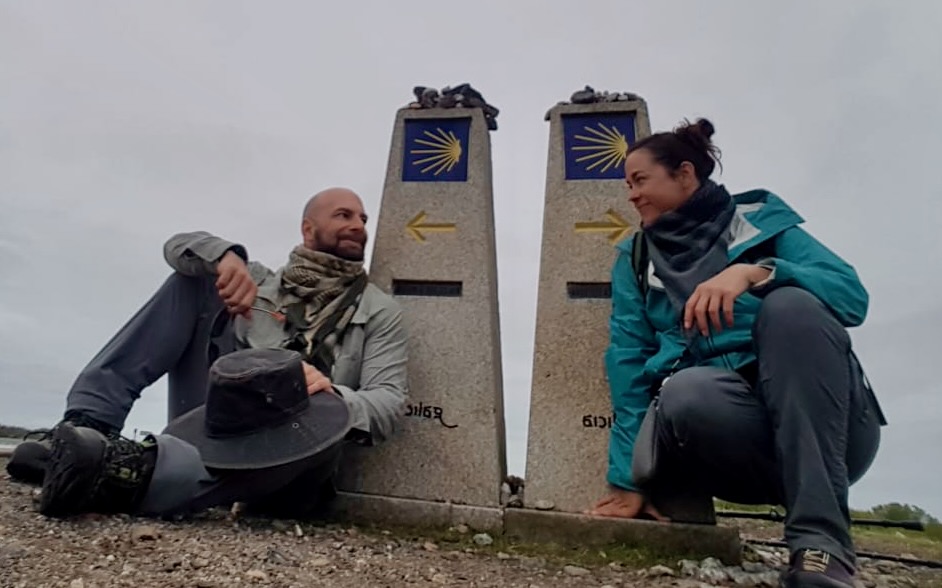
We're pilgrims. We love the Camino de Santiago — the ancient network of pilgrimage routes across Spain and Portugal that draws hundreds of thousands of walkers each year. If you haven't heard of it, picture walking 800 kilometres across northern Spain over the course of five or six weeks, staying in small towns and villages, carrying everything you need on your back.
When you're planning a Camino, weather is everything. It determines what gear you pack, what clothes you bring, whether you need rain protection or sun protection (often both), and sometimes whether certain mountain passes are even safe to cross. But here's the challenge: you're not going to one destination. You're going to dozens of destinations, spread across weeks, crossing different climate zones as you move from the Pyrenees through the Meseta and into Galicia.
Before our first Camino, we spent hours researching historical weather data for each region, month by month, trying to build a mental picture of what we'd face. What are the temperatures like in Navarra in September? How much rain should we expect in Galicia in October? Is it still hot on the Meseta in late September, or has autumn arrived? There was no single tool that could answer these questions for a multi-week, multi-destination journey.
What we actually needed
Walking the Camino made it crystal clear what was missing from every weather app on the market:
- Multi-day, multi-destination forecasts — not just "what's the weather in Santiago?" but "what's the weather at each of our 35 planned stops, on the day we'll be at each one?"
- Historical climate data for planning ahead — when your trip is months away, standard 7-day forecasts are useless. You need seasonal averages and ranges so you can make informed decisions about what to pack and when to go
- Seamless transition from outlook to forecast — as the trip gets closer, you want real forecast data to replace the historical averages, automatically, without having to switch tools
- Weather that matters to people on foot — not just temperature and rain, but wind speed and direction (are you walking into a headwind?), UV index (are you exposed on a treeless plateau?), humidity and heat stress (is it safe to walk in the afternoon?), and even fire danger in regions where it's relevant
- An itinerary editor that understands multi-day journeys — where you can add stops, set durations, reorder them, and have all the dates cascade automatically
Building something that didn't exist
We looked for an app that did this. We really did. There are excellent weather apps out there — apps with beautiful interfaces, accurate forecasts, and detailed data. But every single one is designed for the same use case: you're in one place, and you want to know what the weather is doing there right now, or maybe this week.
None of them could answer: "We're walking from Saint-Jean-Pied-de-Port to Santiago de Compostela over the next 35 days. What weather should we prepare for at each stage?"
So we built Wayfarer.
From commute to Camino to everywhere
What started as a solution for a Melbourne commute grew into something much bigger when we applied the same thinking to long-distance walking. And then we realised it applies to almost any kind of travel.
Cyclists planning multi-day touring routes need to know about wind direction at each stop. Surfers heading to the coast want wave height and sea surface temperature overlaid on their trip dates. Families planning a two-week holiday across multiple countries want to know whether to pack for heat in Italy and rain in Scotland. Digital nomads hopping between cities want a recurring view of weather at their regular destinations.
The core insight is the same in every case: travellers don't stay in one place, and their weather app shouldn't either.
What Wayfarer is today
Wayfarer has grown into a full-featured travel weather companion. It aggregates data from multiple global weather models to find the most accurate forecasts for any location on Earth. It provides everything from 15-minute current conditions to 14-day forecasts to month-by-month seasonal outlooks built from decades of historical data.
The itinerary editor lets you build complex multi-stop routes or use pre-loaded templates like the Camino de Santiago. Recurring trips handle the regular commute use case. Over 20 weather metrics — from temperature and wind to UV, humidity, dew point, wet bulb temperature, heat stress, fire danger, and full marine weather — are all colour-coded with configurable thresholds so you can assess conditions at a glance.
It's offline-first, so your data is always available even when you're on a remote trail with no signal. It's a Progressive Web App you can install on any device. And it's available in six languages because the Camino attracts pilgrims from all over the world.
For everyone who moves
Whether you're a pilgrim walking across Spain, a cyclist touring the Alps, a surfer chasing swells down the coast, or just someone who commutes between two cities a few times a week — Wayfarer was built for you. We built it because we needed it ourselves, and because we believed travellers deserved a weather app that actually understood how they move through the world.
We hope it makes your next journey a little easier to plan, a little safer to navigate, and a lot less frustrating than switching between locations in a regular weather app.
Buen Camino. 
Ready to try Wayfarer?
See the weather for where you'll be, when you'll be there.